

Reviewed · JERUSALEM OLD CITY TOURS
Classic Jerusalem Old City Tour – Dguide Self Guiding App
Jerusalem’s Old City is best approached in layers, and this self-guided DGuide tour lets you set the pace. You begin at Jaffa Gate, then move through Roman streets, ancient ruins, sacred sites, and the Western Wall before reaching the Church of the Holy Sepulchre. Uri Goldflam, a guide and educator with 30 years of experience, provides the commentary through the app.
I like two things right away: you can stop the narration when a church, market lane, or view catches your attention, and you can leave the suggested route, explore, then return to it later. The price is also hard to ignore at $7 per person, though museum entry fees are extra and you will need a phone, battery, and a reasonable tolerance for stairs.
- A flexible route through eight major Old City sights, including Jaffa Gate, Mount Zion, the Cardo, the Western Wall, and the Church of the Holy Sepulchre.
- Historical context from Uri Goldflam, whose guiding and teaching experience shapes the app’s commentary.
- A 360-degree view from the Tower of David, with admission available for an additional fee.
- Ancient Jerusalem beneath your feet, including Roman paving, the Herodian Quarter, and a 2,700-year-old water relic.
- A low-cost private experience, since only your own group follows the tour.
- A walk that requires moderate fitness, with stairs and uneven Old City routes likely to slow the pace.
A smart way to begin Jerusalem’s Old City

The route starts at Jaffa Gate, one of the clearest entry points into Jerusalem’s walled center. This first stop is short, about 10 minutes, but it matters. Before you enter, the app helps you understand where you are and sets up the transition from modern Jerusalem into the tightly packed Old City.
I like starting here because Jaffa Gate is easy to identify and close to public transportation. You will not need to hunt for a small office or wait for a group to gather. The meeting point is listed at Jaffa Gate hostel, and the tour ends back at the meeting point.
From here, you enter the Old City on foot. Keep your phone ready, but do not stare at it every second. Jerusalem rewards looking up at stone walls, gates, rooftops, and passing life. The value of a self-guided format is that you can listen, pause, and pay attention to your surroundings instead of keeping up with a guide’s fixed pace.
Tower of David and the best city view
The Tower of David Museum occupies Jerusalem’s ancient citadel, making it one of the strongest early stops on this route. The site combines fortifications, archaeology, and a broad view over both the Old City and the newer parts of Jerusalem.
The suggested visit lasts about an hour. That is a generous block of time, especially if you choose to enter the museum rather than simply hear the app’s explanation from outside. Admission is not included, so you should check the current entry cost before setting out and decide if the museum fits your budget.
The main payoff is the 360-degree view from the citadel. This is one of the few points on the route where the city’s shape becomes clear. You can better understand how the Old City sits within modern Jerusalem, rather than experiencing it only as a maze of lanes.
The stop also touches on the possible location of Jesus’s trial. The wording matters: this is a traditional or possible association, not a claim that can be treated as certain. That careful distinction is useful in Jerusalem, where sacred tradition, archaeology, and later interpretation often overlap.
More City Tours in Jerusalem
- Jerusalem: Guided Walking Tour of the Old City
★ 4.7 · 386 reviews - Full Day City Tour of Jerusalem
★ 4.1 · 367 reviews - From Jerusalem Small group tour Old&New City ENTRY FEES INCL
★ 4.0 · 135 reviews
Mount Zion’s three major sacred sites
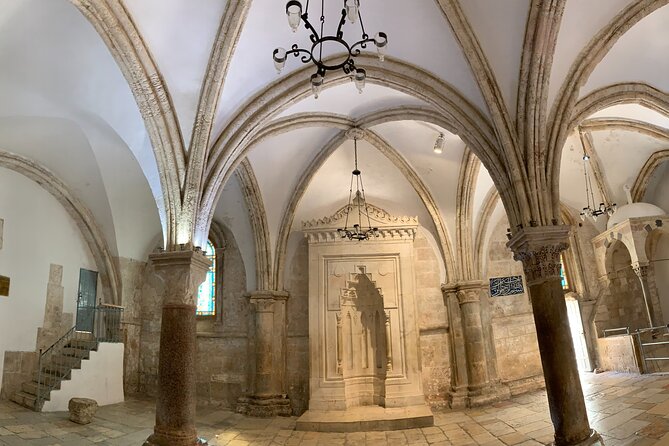
Next comes Mount Zion, with about 30 minutes set aside for three important places: the Dormition Abbey, the Upper Room, and the traditional tomb of King David.
The Dormition Abbey is connected with the tradition that Mary spent her final days here. The Upper Room is associated with the Last Supper, while the nearby tomb of King David reflects a long-standing Jewish tradition. You are not simply checking off three buildings. You are moving through places claimed by different faith traditions, each carrying its own stories and layers of meaning.
This section works well for people with a strong interest in Christian and Jewish heritage. Uri Goldflam’s background includes both traditions, and his commentary is designed to explain the religious and historical links between the sites.
You should also expect a change in pace. Mount Zion is not just a single viewing platform. You may need to move through entrances and stairs, and your visit can take longer if one of the sites is busy or if you spend time inside. The route gives you freedom to pause, but your total visit could stretch beyond the short estimate.
Walking the Roman Cardo of Jerusalem
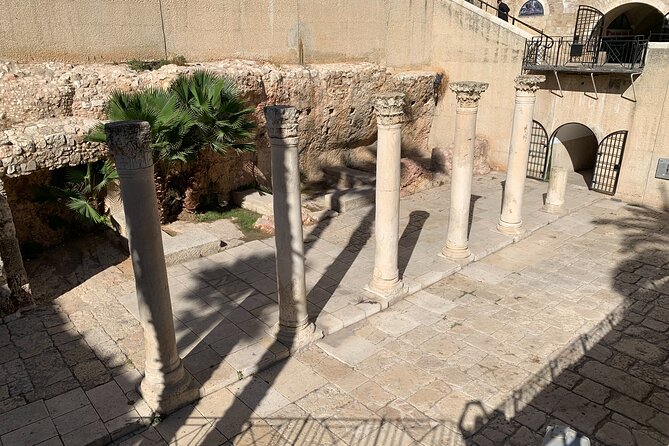
The next station takes you into the Roman Cardo, the main north-south street built during Jerusalem’s rebuilding under Emperor Hadrian in the first half of the second century.
Here, the appeal is physical. You can walk along Roman pavement and picture the Old City as a planned Roman settlement rather than only a biblical or medieval one. The ancient stone route gives the past a solid presence under your feet.
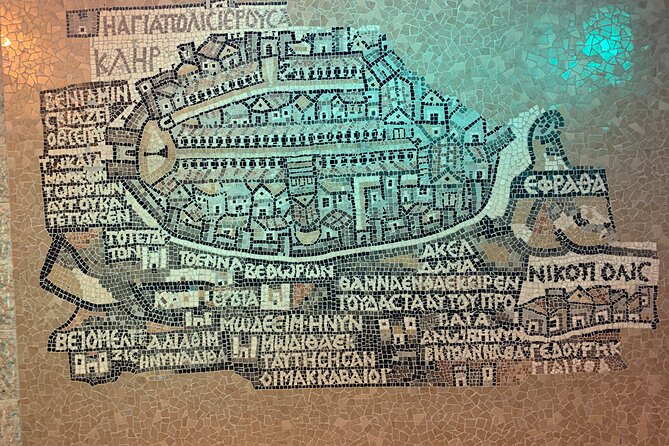
The tour also points out a replica of the Madaba Map, one of the oldest known maps of Jerusalem. The original sixth-century mosaic map is in Jordan, so the replica offers a practical way to study how Jerusalem was represented in the early Christian period.
This is a good example of why the app format can work. You can stop beside the remains, listen to the explanation, then spend a few minutes studying the details without holding up a group. If you are moving quickly, though, it is easy to treat the Cardo as just another lane. Give it time. The Roman street is one of the stops that changes how you read the Old City.
The 2,700-year-old water relic

One station focuses on a relic connected with Jerusalem in the Bible and the time of King Hezekiah, roughly 2,700 years ago.
The supplied details do not identify the exact relic by name, so I would use the app’s explanation to understand what you are seeing rather than expect a large, obvious monument. The important point is the age. This stop reaches back before the Roman period and links the modern city to the era of the ancient kings of Judah.
For you, this is a reminder that Jerusalem’s story is not limited to the best-known religious buildings. Some of the most meaningful evidence can be modest, partly buried, or easy to miss without interpretation. The app helps give that small remnant a place in the larger story.
more old city quarters to walk
- Best seller! Jerusalem old city four quarters tour
★ 5.0 · 123 reviews - Private Tour Jerusalem Old City
★ 5.0 · 118 reviews - All Inclusive Walking Tour Old City Jerusalem
★ 5.0 · 83 reviews - Jerusalem Half Day Tour: Holy Sepulchre and Western Wall
★ 4.5 · 80 reviews
Herodian Quarter and the destruction of 70 AD

The Herodian Quarter, also called the Wohl Archaeological Museum, takes you into excavated first-century Jerusalem. The suggested visit is about 30 minutes, and admission is not included.
This stop offers a powerful contrast with the Roman Cardo. The Cardo shows a later rebuilding of the city. The Herodian Quarter reveals the homes and possessions of Jerusalem’s elite before the Roman destruction in 70 AD.
You can expect to see large residences, costly decorations, and evidence of the city’s wealth. That prosperity makes the destruction more striking. Archaeology here helps you understand that Jerusalem was not only a sacred center. It was also a city of substantial private homes, social rank, and material wealth.
The museum is worth considering if you enjoy archaeology and want more than views of religious sites. It does add cost, and entering two museums can push the outing toward the longer four-hour end. If your time or budget is tight, you can still follow the app’s route and decide on the spot.
The Western Wall and the Temple Mount
The Western Wall is the route’s major Jewish religious site. It is a surviving section connected with the Temple complex and is the closest place to the Temple Mount where Jews can pray.
The suggested stop lasts about 20 minutes. That may be enough for a first look, but your actual time will depend on how you experience the plaza and whether you want to pause for prayer or reflection.
The app can give you the historical setting, but it cannot replace the need for respectful behavior. Dress and conduct should reflect the religious importance of the site. Since the route is self-guided, you are responsible for deciding when to listen and when to put the phone away.
This stop is also a useful point for thinking about the Old City’s overlapping identities. The Western Wall is a place of living faith, not simply an archaeological remnant. That difference gives the route emotional weight.
The Church of the Holy Sepulchre
The final major stop is the Church of the Holy Sepulchre, associated by Christian tradition with the crucifixion and resurrection of Jesus.
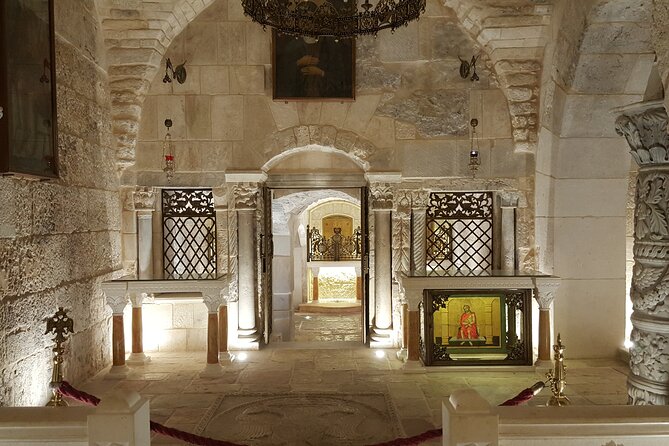
The church was first built in the fourth century and has gone through many reconstructions. That long building history is part of the experience. You are not seeing one untouched structure from antiquity, but a living holy place shaped by damage, rebuilding, and centuries of worship.
The suggested visit is about 30 minutes, though the setting can make that estimate flexible. You may find that the church requires patience and careful attention. There are several significant areas within the complex, and the app’s explanations help you understand why the church matters to different Christian traditions.
I especially like ending here because the route brings together the themes introduced at the beginning: archaeology, sacred tradition, political change, and the physical city. The Western Wall and Holy Sepulchre are close in geographic terms, yet each expresses a different religious connection to Jerusalem.
What $7 really gets you
At $7 per person, this is an inexpensive way to bring structure to an Old City visit. You are paying for access to the DGuide route and its recorded content, not for a guide who walks beside you and answers questions in real time.
That distinction is important. Uri Goldflam receives repeated praise for being articulate, funny, accommodating, and exceptionally well informed during his longer guided programs. Here, his experience shapes the material in the app, but you should not expect personal interaction during the walk.
The value is strongest if you want a private experience for your own group and prefer to control the pace. A family can pause. A couple can linger at a church. A history enthusiast can spend longer in the Herodian Quarter. You are not paying for a fixed group schedule.
Museum admissions are extra at the Tower of David Museum and the Wohl Archaeological Museum. Parking fees are also not included. The tour is near public transportation, so using a car may add cost and hassle without much benefit.
How long the walk takes
The advertised duration is about 2 to 4 hours. That range is sensible because the route can be used in different ways.
A fast visit that follows the commentary and views the main sites from outside may fit near the shorter end. Enter both museums, listen to every station, pause at Mount Zion, and take time at the religious sites, and you will likely need closer to four hours.
The individual time blocks add up to a substantial walk:
- Jaffa Gate: about 10 minutes
- Tower of David: about 1 hour
- Mount Zion: about 30 minutes
- Herodian Quarter: about 30 minutes
- Western Wall: about 20 minutes
- Church of the Holy Sepulchre: about 30 minutes
The Cardo and the ancient water relic add further time. The route requires walking and stairs, and a moderate fitness level is recommended. You should wear practical shoes and leave room in your schedule for pauses, even though those basic preparations are not formally listed as tour inclusions.
Using the DGuide app without losing the city
The DGuide app is free. After booking, you receive a coupon code in the Before You Go section of the confirmation email. You use that code to access the Classic Jerusalem Old City Tour.
Download or open the app before reaching Jaffa Gate, and make sure you can find the code. A phone with a charged battery is essential because your commentary, route, and timing all depend on it. The supplied details do not promise offline access, so I would not assume the route works without a data connection.
The app’s greatest strength is flexibility. Follow the suggested route when you want clear direction, then wander off course when something catches your eye. You can return to the guided route later, which is far less stressful than trying to stay with a moving group.
The tradeoff is that you must manage the experience yourself. If you miss a turn, want to ask a question, or need help interpreting something outside the programmed stops, there is no live guide beside you. For some people, that freedom is the point. For others, a human guide will be worth the higher price.
Who should book this Old City tour
I would choose this tour if you want a low-cost introduction to Jerusalem’s major sacred and archaeological sites, especially if your group likes to move independently.
It fits you well if:
- You want to stop often or change the pace.
- You prefer listening to history on your own schedule.
- Your group has different interests and may split briefly.
- You are comfortable using a phone for navigation and commentary.
- You want both Christian and Jewish sites in one route.
- You are willing to pay separately for museum entry.
I would think twice if you need constant personal guidance, have limited mobility, or dislike walking on routes with stairs. The tour does not provide a vehicle, parking, or a live escort. It also cannot guarantee that every site will be equally easy to enter at every moment.
The provider lists operating hours from Monday through Thursday, 8:00 AM to 5:00 PM, for the stated operating period. Confirm the available date and start time before booking, especially if your schedule includes Friday, Saturday, or Sunday.
Should you book the DGuide Jerusalem route?
Book it if you want an affordable, flexible framework for seeing the Old City and you are happy to be your own guide. The route covers an impressive range in 2 to 4 hours, from Roman paving and first-century homes to the Western Wall and the Church of the Holy Sepulchre.
The strongest reason to choose it is the balance between structure and freedom. Uri Goldflam’s long experience gives the commentary a solid foundation, while the app lets you pause, skip, or wander. Just budget for museum admissions, prepare for stairs, and remember that the app cannot answer follow-up questions like a live guide.
Free cancellation is available if you cancel at least 24 hours before the local start time. If the price, walking level, and self-guided format suit you, this is a practical way to make your first Old City visit more meaningful without spending heavily.
FAQ
How much does the Classic Jerusalem Old City Tour cost?
The tour costs $7 per person. Admission to the Tower of David Museum and the Wohl Archaeological Museum is not included, and parking fees are also extra.
Is a live guide included?
No. This is a self-guided experience using the free DGuide app. Uri Goldflam designed the route and its content, but he does not accompany you in person as part of this activity.
Where does the tour begin and end?
The tour begins at Jaffa Gate hostel near Jaffa Gate in Jerusalem. It ends back at the meeting point.
How long does the tour take?
The expected duration is approximately 2 to 4 hours. The time depends on your pace, how long you spend at each site, and whether you enter the museums.
What does the tour include?
Your purchase includes access to the Classic Jerusalem Old City Tour through the DGuide app. The app itself is free, and the access coupon code appears in the Before You Go section of your confirmation email.
Is the tour suitable for people with limited mobility?
The tour requires walking and using stairs, and a moderate level of physical fitness is recommended. The supplied information does not describe it as accessible for people with limited mobility.
More Self-Guided Tours in Jerusalem
- In The Footsteps of Jesus Day Tour – Dguide Self Guiding App
★ 4.5 · 3 reviews - From Tel Aviv: Dead Sea Self-Guided Chill-Out Day Trip
★ 4.2 · 64 reviews
Recently added around Jerusalem
- Holy Jerusalem Full Day Tour from Jerusalem★ 5.0 · 3 reviews
- Half day tour bethlehem prices per Van up to 6 pax★ 5.0 · 3 reviews
- jerusalem classic tour★ 5.0 · 3 reviews
- Private Walking Tour in Jerusalem’s Old City★ 5.0 · 3 reviews
- Private Tour to the Culinary World of Jerusalem Market★ 5.0 · 3 reviews
- Private Tour Bethlehem and the Dead Sea★ 5.0 · 3 reviews
- From Jerusalem: Masada Sunrise, Ein Gedi & Dead Sea★ 5.0 · 3 reviews
- Jerusalem Like a Local: Customized Private Tour★ 5.0 · 3 reviews
Jerusalem Old City Tours, compared.

From Tel Aviv: Jerusalem Old City & Dead Sea Guided Day Tour
Read our review →


Jerusalem Half Day Tour: Holy Sepulchre and Western Wall
Read our review →
Jerusalem Half-Day Tour from Tel Aviv: Holy Sepulchre and Western Wall
Read our review →


Jaffa: Old City, Port & Shuk Hapishpishim Walking Tour
Read our review →Browse the lists this tour appears in